What is Bitget Futures Trading: A Comprehensive Guide for Global Traders

Bitget has rapidly evolved into a leading global derivatives exchange, providing a sophisticated yet accessible environment for crypto futures trading. For traders worldwide, the platform serves as a vital gateway to leverage market volatility with precision. By engaging in futures trading, you are essentially entering into a contract to buy or sell an asset at a predetermined price on a future date, allowing for both hedging and aggressive speculation.
My personal experience with the platform over the years highlights that Bitget stands out due to its exceptional liquidity and a highly intuitive interface. Unlike spot trading, where you own the underlying asset, futures trading on Bitget empowers you to utilize leverage. This mechanism enables you to control larger positions with a smaller amount of capital, effectively amplifying both your potential returns and your risk exposure.
The Core Distinction: Understanding Futures vs. Spot Trading
To succeed in the crypto markets, it is crucial to recognize how futures differ from traditional spot market activities. The following table provides a detailed comparison to help you determine which style aligns with your trading strategy.
| Feature | Spot Trading | Futures Trading (Bitget) |
|---|---|---|
| Asset Ownership | Full Ownership | Contractual Agreement |
| Leverage | Not Available | Up to 125x |
| Market Direction | Long Only (Buy low, sell high) | Long & Short (Profit in any direction) |
| Risk Level | Moderate | High (Requires strict risk management) |
| Profit Potential | Linear | Exponential |
Why Global Traders Prefer Bitget for Futures
Bitget is widely recognized for its Copy Trading feature, which remains the gold standard in the industry. For beginners, this tool offers a unique opportunity to replicate the strategies of expert traders automatically. My professional observation is that this feature significantly lowers the barrier to entry for newcomers who want to learn while simultaneously participating in the market.
Furthermore, Bitget’s robust risk management tools, such as Stop-Loss and Take-Profit orders, are seamlessly integrated into the trading terminal. These features allow you to automate your exits, protecting your capital even when you are away from your screen. In my opinion, the combination of deep order books and consistent platform reliability makes Bitget a premier choice for institutional and retail traders alike.
Rating: ⭐⭐⭐⭐⭐ (5/5)
As you embark on your futures trading journey, remember that discipline is more important than raw analytical skill. The platform provides all the necessary technical indicators, but your strategic mindset remains the most important asset in your portfolio. Mastering these foundational concepts will prepare you for the step-by-step execution procedures we will explore in the following sections.
Step-by-Step Guide: How to Get Started with Bitget Futures
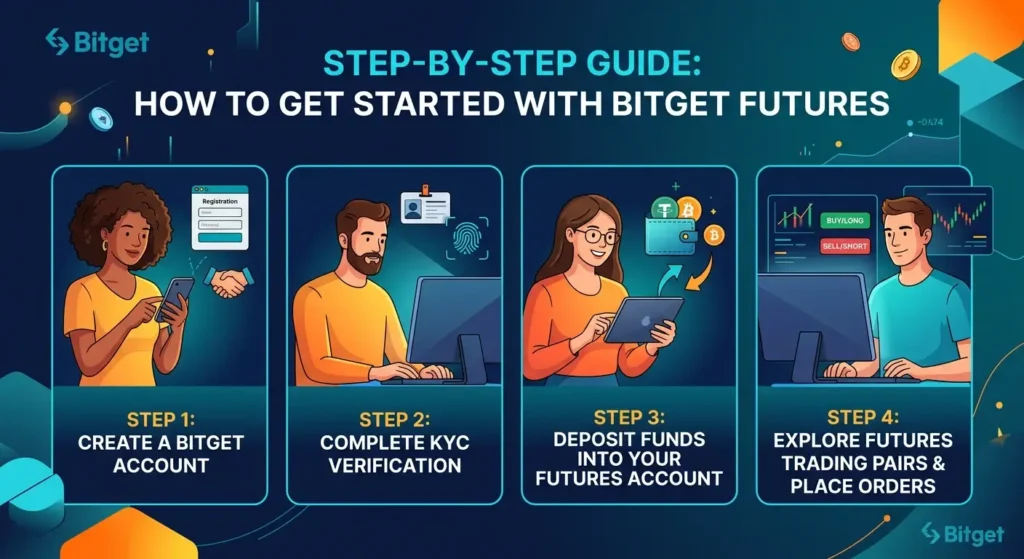
To begin your journey into Bitget futures trading, you must first establish a secure and funded account. Follow this structured process to navigate the platform effectively and minimize unnecessary friction during your initial trades.
Phase 1: Account Setup and Fund Deposit
- Account Creation: Register using your email or phone number. Complete KYC verification immediately to unlock higher withdrawal limits and full platform functionality.
- Deposit Funds: Navigate to the ‘Assets’ tab. Select ‘Deposit’ to transfer USDT or USDC from an external wallet or use the P2P trading portal to purchase crypto with fiat currency.
- Internal Transfer: You must transfer your funds from your Spot Account to your USDT-M Futures Account via the internal transfer function.
Phase 2: Executing Your First Futures Trade
Once your collateral is in the futures account, navigate to the ‘Trade’ menu and select ‘Futures’. Follow these precise steps to place your first order:
- Select Trading Pair: Choose your preferred market, such as BTC/USDT or ETH/USDT, from the top left corner.
- Choose Margin Mode: Select either Cross Margin (sharing the balance) or Isolated Margin (limiting risk to a specific position).
- Adjust Leverage: Use the slider to set your leverage. Beginners should strictly stay between 1x and 5x to avoid liquidation due to high volatility.
- Order Type Selection: Choose between Limit Orders for price control or Market Orders for instant execution.
- Confirm Entry: Click ‘Open Long’ if you anticipate a price rise, or ‘Open Short’ if you expect a market correction.
Comparison: Margin Modes for Futures Trading
Understanding the difference between margin modes is the most critical decision a trader makes before clicking the ‘Open’ button.
| Feature | Isolated Margin | Cross Margin |
|---|---|---|
| Risk Scope | Only the allocated collateral | Entire balance in the account |
| Liquidation Risk | Higher for the specific position | Lower, as it utilizes all available funds |
| Best For | Short-term speculative trades | Hedging and professional strategy |
| Account Impact | Independent | Shared across all open positions |
Professional Insights on Trading Strategy
In my professional experience, the most common mistake newcomers make is over-leveraging. Even with a perfect entry, market noise can liquidate a highly leveraged position in seconds. I recommend using Isolated Margin for your first ten trades to isolate your risk and protect your main portfolio balance.
Furthermore, always utilize the TP/SL (Take-Profit/Stop-Loss) function immediately after opening a position. This removes emotional decision-making from the equation. Bitget’s interface allows you to set these values at the moment of order creation, which I consider the best practice for disciplined long-term growth.
Execution Efficiency Rating: ⭐⭐⭐⭐⭐ (5/5)
By strictly following this procedure, you ensure that your capital is managed professionally. Focus on risk-to-reward ratios rather than hit rate, as even a 40% win rate can be highly profitable if your loss-per-trade is kept under 2% of your total equity.
Maximizing Your Gains: Understanding Bitget Bonus and Reward Programs

Bitget stands out in the competitive crypto landscape by offering a multi-tiered reward ecosystem designed to accelerate your trading journey. Beyond standard trading fees, these incentives serve as a vital buffer for your capital, effectively reducing your breakeven point on every volatile trade.
The Bitget Reward Center: Your Gateway to Extra Capital
The Bitget Reward Center acts as a centralized dashboard where traders complete specific missions to earn Trading Bonuses and Coupons. These are not merely marketing gimmicks; they are tangible assets that can cover up to 50% of your trading fees or be used as margin for opening futures positions.
- Newcomer Tasks: Complete identity verification and your first deposit to unlock initial signup bonuses.
- Futures Trading Volume Milestones: Scale your trading activity to trigger tiered rebates and cashback vouchers.
- Referral Program: Leverage your network to earn ongoing commission rebates from your invitees’ trading fees.
Differentiating Bitget Bonus Types
Understanding the distinction between a Trading Bonus and a Trial Fund/Coupon is critical for professional risk management. The table below illustrates how these incentives function within your account.
| Feature | Trading Bonus | Deduction Coupon | Trial Fund |
|---|---|---|---|
| Primary Use | Margin for opening positions | Offsetting transaction fees | Offsetting trading losses |
| Withdrawability | No (Only profits) | No | No |
| Expiration | Yes (Strict) | Yes | Yes |
| Flexibility | High (Used as collateral) | Medium (Fee-based) | Low (Safety net) |
Strategic Utilization of Rewards
From my perspective, treating bonuses as risk-free capital is the key to mastering the platform. When you open a position using a Trading Bonus, you are essentially trading with house money. This allows you to test high-conviction setups without exposing your actual USDT balance to drawdown.
Professional Tip: Always prioritize using your Deduction Coupons during periods of high-frequency trading. Scalpers often lose 15-20% of their net profit to transaction fees. By applying these coupons, you retain a larger portion of your net gains, which compounds significantly over a month of active trading.
Bonus Efficiency Rating: ⭐⭐⭐⭐☆ (4.5/5)
How to Claim and Activate Your Rewards
Navigating the reward system is straightforward if you follow this standardized workflow to maximize your benefit:
- Access the Dashboard: Log into your account and navigate to the ‘Rewards Center’ tab via the top navigation bar.
- Verify Tasks: Review the active missions. Ensure you complete KYC (Know Your Customer) verification first, as it is a prerequisite for most bonuses.
- Deposit and Trade: Fund your futures account and execute the required volume. The platform tracks your progress automatically in real-time.
- Claim and Activate: Click the ‘Claim’ button. Once claimed, the bonus reflects in your futures asset wallet immediately.
- Apply to Orders: When opening a new position, select the ‘Bonus’ toggle in the order window to utilize the funds as margin.
I advise traders to avoid the temptation of over-trading just to reach the next volume milestone. While the bonuses are attractive, the potential loss from forced trades usually outweighs the value of the reward. Maintain your discipline, and let the bonuses flow in as a natural byproduct of your consistent trading strategy.
Understanding Bitget Futures Fee Structure
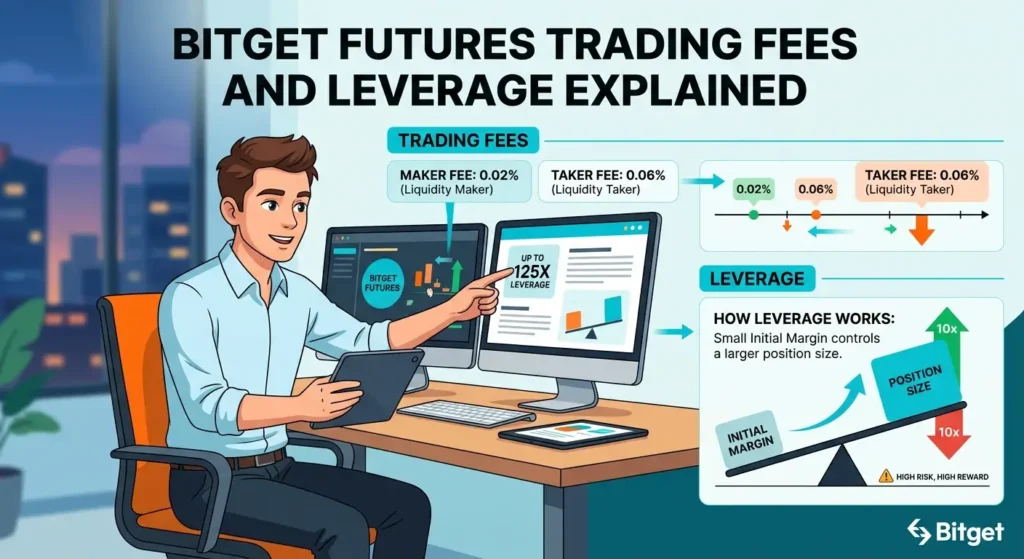
To master Bitget futures trading, you must first demystify the fee architecture. Bitget employs a Maker-Taker model, which determines your costs based on whether you provide liquidity or remove it from the order book.
- Maker Fees: Applied when your order is placed on the book and isn’t filled immediately. This adds depth to the market and typically incurs lower fees.
- Taker Fees: Applied when your order matches instantly with an existing order. You are removing liquidity, hence the higher cost.
I highly recommend utilizing limit orders whenever possible. By acting as a Maker, you not only reduce your transaction overhead but also maintain tighter control over your entry prices, which is critical for intraday scalping.
Comparative Analysis: Bitget Fee Tiers and Leverage Limits
The table below compares the fee structures and leverage capabilities for standard futures compared to other tier-1 exchanges. Bitget maintains a highly competitive edge for both retail and institutional traders.
| Feature | Bitget Futures | Competitor A | Competitor B |
|---|---|---|---|
| Maker Fee | 0.02% | 0.02% | 0.04% |
| Taker Fee | 0.06% | 0.05% | 0.06% |
| Max Leverage | 125x | 125x | 100x |
| Interface Ease | ⭐⭐⭐⭐⭐ | ⭐⭐⭐⭐☆ | ⭐⭐⭐☆☆ |
Strategic Leverage Management
Leverage is a double-edged sword that amplifies both gains and losses. While Bitget offers up to 125x leverage, I strongly advise newcomers to start within the 3x to 5x range to preserve capital during high market volatility.
Key Risks to Consider:
- Liquidation Price: As you increase your leverage, your liquidation price moves closer to your entry price.
- Funding Rates: Every 8 hours, traders pay or receive funding fees to keep the contract price pegged to the spot market.
- Isolated vs. Cross Margin: Use Isolated Margin to restrict potential losses to a specific position, protecting your remaining USDT balance.
Professional traders often switch to Cross Margin only when they have a highly hedged portfolio. For most individual users, Isolated Margin remains the gold standard for strict risk management and account longevity. Never over-leverage your position simply because the platform permits it; the house always wins when you trade emotionally.
Efficiency in margin management directly correlates with long-term survival. Always monitor your margin ratio, especially when holding large long or short positions during high-impact economic data releases like CPI or FOMC meetings.
Bitget Copy Trading: A Deep Dive into Social Intelligence

One of Bitget’s most compelling features is its Copy Trading ecosystem. It allows users to automatically mirror the positions of professional traders. Having tested this for several months, I find it an excellent bridge for those who lack the time to analyze technical indicators or global market trends daily.
Selecting the Right Elite Trader
Success in Copy Trading depends entirely on your selection process. Do not blindly follow traders with high total ROI. Instead, look for consistent performance over a 90-day period. Analyze their Win Rate, maximum drawdown, and the types of assets they trade to ensure they align with your risk appetite.
| Metrics | Top Tier Trader | Average Trader | High-Risk Trader |
|---|---|---|---|
| 90-Day ROI | +150% ~ +300% | +20% ~ +50% | +500%+ |
| Win Rate | 85% – 95% | 60% – 70% | 40% – 50% |
| Max Drawdown | <10% | 15% – 25% | >50% |
| Reliability Rating | ⭐⭐⭐⭐⭐ | ⭐⭐⭐☆☆ | ⭐☆☆☆☆ |
Step-by-Step Guide to Copy Trading
- Step 1: Navigate to the Copy Trading tab on the Bitget main menu.
- Step 2: Use the filter tools to sort by ROI, AUM (Assets Under Management), and risk levels.
- Step 3: Click “Follow” on your chosen trader to open the configuration settings.
- Step 4: Set your Fixed Amount or Multiplier to control how much margin is used per trade.
- Step 5: Configure your Stop-Loss and Take-Profit ratios to protect your capital automatically.
Personal Insight: The Pitfalls of Automation
While automated trading offers convenience, it is not a “set and forget” solution. I personally monitor my Copy Trading performance daily. Sometimes, elite traders experience a sudden streak of losses due to market manipulation or unexpected volatility. If you see your balance dropping significantly, do not hesitate to unfollow and re-evaluate your strategy.
I recommend allocating only a small portion of your USDT wallet to copy trading. Diversifying between manual scalping and following an expert creates a balanced portfolio. This approach mitigates the risk of a single bad trader liquidating your entire trading account.
Bitget Bonus and Reward System
Bitget’s Bonus Program is particularly generous for new users who complete their KYC verification and initial deposits. These bonuses usually come in the form of trading vouchers, which can be used to offset trading fees or cover losses in specific scenarios. Always read the terms, as these bonuses often expire if not utilized within a set timeframe.
Maximizing Your Rewards:
- Task Center: Complete daily tasks like spot trading or inviting friends to unlock reward points.
- Deposit Bonus: Ensure you hit the minimum deposit thresholds during promotional events to trigger welcome bonuses.
- Coupons: Use deduction coupons to significantly lower your fee impact during high-frequency trading sessions.
Pros and Cons: Is Bitget the Right Choice for Your Crypto Journey?

Choosing the right crypto exchange is a pivotal decision that impacts your daily trading performance and long-term security. Bitget has carved out a unique space, particularly in the derivatives market. However, no platform is perfect. Here is an analytical breakdown of whether Bitget aligns with your specific trading goals.
The Advantages of Bitget’s Ecosystem
The primary draw of Bitget is its high liquidity and low-latency engine. These features are critical for traders engaging in high-frequency scalping. You rarely encounter the slippage issues often found on smaller, less established exchanges.
- Advanced Order Types: Bitget offers sophisticated options like Post-Only, IOC, and FOK orders, providing precise control over trade execution.
- Social Trading Dominance: Their Copy Trading platform is arguably the most intuitive in the industry, lowering the barrier for entry for beginners.
- Comprehensive Liquidity: With a massive user base, even large orders are filled quickly without causing extreme price deviations in the order book.
The Potential Drawbacks
Despite its strengths, users must be aware of the complexities inherent in such a feature-rich environment. The user interface can feel overwhelming for absolute newcomers who are not familiar with financial terminology.
- Interface Complexity: The abundance of tabs and settings can distract users from simple spot trading activities.
- High Leverage Risks: Bitget allows for high leverage, which can lead to rapid capital depletion if risk management is not strictly applied.
- Regulatory Evolving Landscape: Like many global exchanges, compliance requirements for users in specific regions may change frequently, necessitating regular KYC updates.
Comparative Analysis: Bitget vs. Industry Peers
To help you decide, I have compared Bitget against other major platforms based on my years of active trading experience. The table below highlights key metrics important for margin traders.
| Feature | Bitget | Binance | Bybit |
|---|---|---|---|
| Copy Trading | ★★★★★ (Excellent) | ★★★☆☆ (Average) | ★★★★☆ (Strong) |
| Trading Fees | ★★★★☆ (Competitive) | ★★★★☆ (Low) | ★★★★☆ (Competitive) |
| Platform UI | ★★★☆☆ (Complex) | ★★★☆☆ (Dense) | ★★★★☆ (User-friendly) |
| Liquidity | ★★★★★ (High) | ★★★★★ (Top-tier) | ★★★★☆ (Very High) |
| Supported Assets | ★★★★☆ (Broad) | ★★★★★ (Massive) | ★★★★☆ (Good) |
My Expert Verdict
In my experience, Bitget shines as a platform for intermediate traders who want to move beyond basic buy-and-hold strategies. If your focus is exclusively on crypto futures and utilizing social trading to learn from others, Bitget is currently the market leader.
However, if you are a conservative investor, the temptation to over-leverage on Bitget might be your greatest enemy. I recommend utilizing their demo trading features extensively before risking real USDT capital. True success on this platform relies not on the features themselves, but on your discipline in maintaining stop-loss protocols and resisting the urge to chase volatile market movements.
Mastering Risk Management in Bitget Futures

Successful futures trading on Bitget is not about finding the perfect trade; it is about surviving long enough to capture market trends. The primary danger for most users is liquidation risk, which stems from poor position sizing and excessive leverage.
To ensure your capital stays protected, you must adhere to the 2% rule. Never risk more than 2% of your total account balance on a single trade. By limiting your exposure, you can weather temporary market volatility without facing a margin call.
Essential Risk Management Tools on Bitget
- Stop-Loss (SL) & Take-Profit (TP): Always set these orders the moment you open a position. Automated exits prevent emotional decision-making.
- Isolated Margin Mode: Beginners should use Isolated Margin rather than Cross Margin to prevent losses from impacting their entire wallet balance.
- Funding Rate Awareness: Always check the funding rate before entering a trade. If the rate is high and negative, you may pay significant fees to hold your position.
Strategic Comparison of Risk Management Features
| Strategy | Effectiveness | Required Discipline | Difficulty |
|---|---|---|---|
| Trailing Stop | ★★★★★ | High | Advanced |
| Grid Trading Bot | ★★★★☆ | Medium | Intermediate |
| Position Scaling | ★★★★☆ | High | Intermediate |
| Manual Over-Leverage | ★☆☆☆☆ | Low | Very Dangerous |
Leveraging Bitget’s Specialized Trading Features
Bitget offers unique tools that, when used correctly, can significantly enhance your profitability. One of the most effective methods is the Bitget Copy Trading system, but it must be used with a strategic mindset. Do not simply copy the highest-ranked trader; analyze their risk-to-reward ratio and their drawdown history over the last 90 days.
When selecting a Lead Trader, look for consistency over short-term spikes in performance. A trader who maintains a steady, moderate growth rate is often more reliable than one who takes massive, reckless risks that eventually lead to catastrophic losses for their followers.
Steps to Set Up a Safe Copy Trade
- Navigate to the Copy Trading dashboard and filter traders by “Lower Risk” and “Stable Returns.”
- Check the trader’s Profit Sharing Ratio and ensure their historical performance aligns with your financial goals.
- Set a hard Copy Stop-Loss limit for each specific lead trader to prevent automatic losses from exceeding your predefined threshold.
- Allocate only a small portion of your USDT portfolio to copy trading to maintain a diversified and healthy balance.
My personal insight: The most successful traders on Bitget treat the platform like a business. They maintain detailed trading journals, review their failed trades to understand their errors, and never allow a single losing day to dictate their long-term investment strategy. Discipline, combined with the right technical tools, is what separates the winners from the liquidations.
Frequently Asked Questions About Bitget Futures and Bonuses

Navigating the complexities of crypto derivatives can be challenging for beginners. Below are the most common inquiries regarding Bitget futures trading and how to maximize your bonus rewards effectively.
Common Questions from Bitget Users
- How do I claim my Bitget welcome bonus? Complete the identity verification (KYC) and reach your first futures trading volume target to unlock reward vouchers.
- Can I withdraw my bonus funds? No, trading bonuses are designed as margin support to cover trading fees or losses; they cannot be directly withdrawn.
- What happens if I hold positions with a bonus? The bonus is utilized automatically to cover transaction fees and potential margin requirements for your open futures orders.
- Is Bitget safe for high-leverage trading? While Bitget provides robust security protocols, high leverage always carries significant liquidation risks; always prioritize risk management.
Comparison: Standard Futures vs. Copy Trading
| Feature | Standard Futures | Copy Trading |
|---|---|---|
| User Control | Full (Manual) | Limited (Automated) |
| Learning Curve | Steep | Easy |
| Fee Structure | Trading Commissions | Profit-Sharing Model |
| Strategic Depth | Highly Flexible | Dependent on Lead Trader |
| Recommended For | Experienced Traders | Beginners & Busy Investors |
Final Summary and Insights
To succeed on Bitget, you must integrate technical analysis with disciplined capital allocation. Never trade based on emotional impulses, as this is the primary cause of account liquidation in the volatile crypto market.
Key Takeaways for Your Success:
- Start Small: Always test your strategies with a small amount of capital before scaling up.
- Leverage Bonuses: Use the Bitget reward center to lower your overall cost of trading through vouchers.
- Continuous Learning: Stay updated with market trends via the Bitget Academy to sharpen your trading edge.
- Risk Management: Always set a stop-loss order to protect your portfolio from unforeseen market reversals.
In my experience, consistency beats high-risk speculation every time. By utilizing Bitget’s bonus programs wisely and maintaining a strict risk-to-reward ratio, you can build a sustainable and profitable trading journey over the long term.
Related guide: Bitget Hedge Mode vs One-Way Mode 2026: Rules, Reduce-Only & Switching